
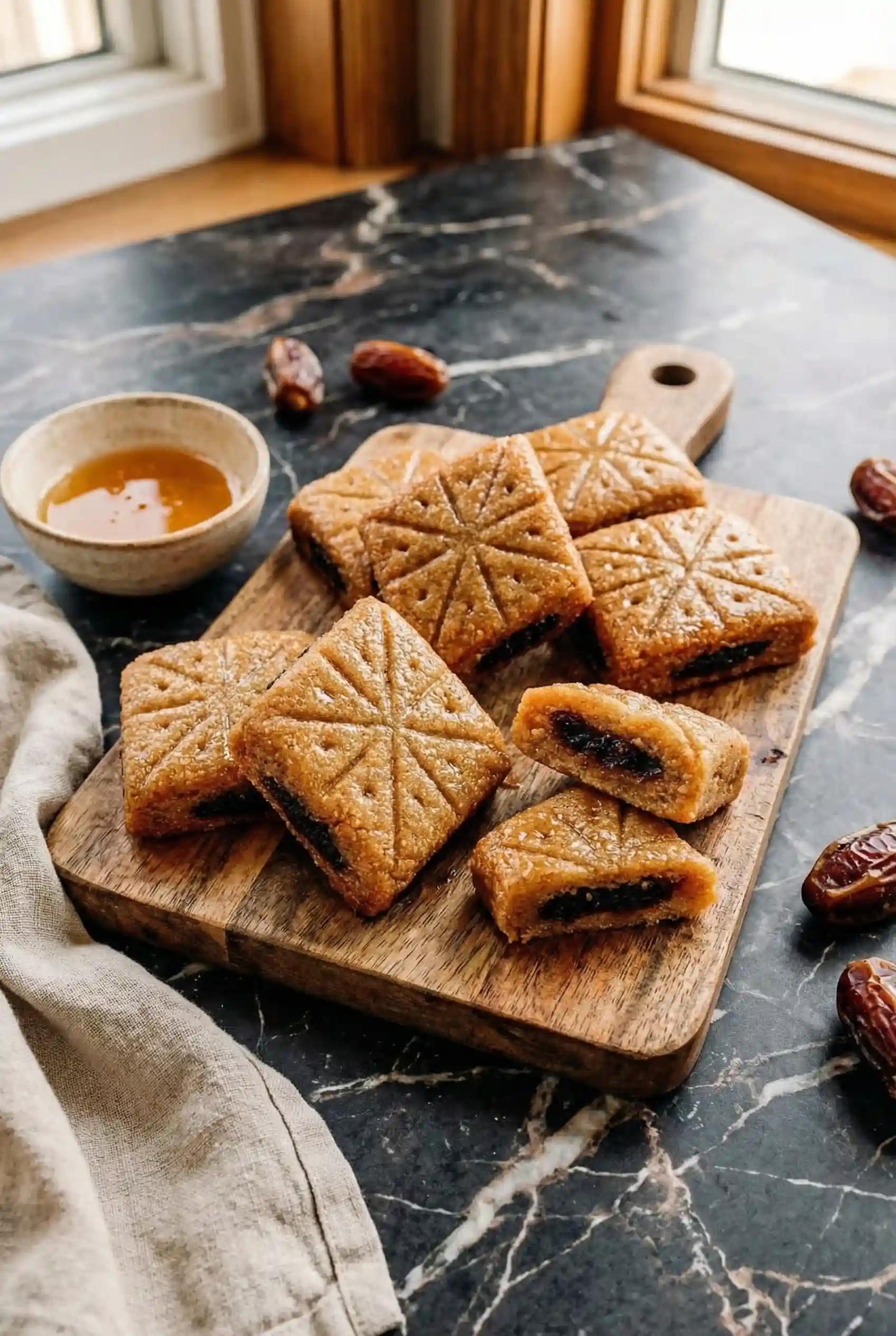
Dates cookies makrout have been a staple in my kitchen every Ramadan for as long as I can remember, and honestly, I think about them the rest of the year too. That crumbly semolina shell, the soft date paste inside, and then that final dip in orange blossom honey… it’s the kind of pastry that makes a whole batch disappear faster than you’d expect.
These little diamond-shaped cookies come from the Maghreb, made across Algeria, Tunisia, and Morocco with slight variations depending on who’s making them. Some families fry them, others bake them. I go for baked because I like a slightly lighter result, but either way the flavor is the same: warm, fragrant, and deeply satisfying. If you’ve never made makrout at home before, this recipe walks you through everything from the semolina dough to the honey coating, step by step.
Ingredients
Semolina Dough
- 1 pinch salt
- 30 g orange blossom water
- 100 g water
- 160 g sweet butter, melted
- 500 g medium wheat semolina
Date Filling
- 1 tsp vanilla extract (liquid)
- 1 tbsp orange blossom water
- 10 g butter, melted
- 300 g date paste
Honey Coating
- 2 tbsp orange blossom water
- 250 ml honey
How To Make Your Dates Cookies Makrout
- Rest the semolina. Place the medium wheat semolina in a large bowl, pour in the melted butter, and work it through with your hands using rubbing motions until every grain is coated. Cover with a clean cloth and let it rest for at least 1 hour (overnight is even better and gives a more cohesive dough).
- Finish the dough. Add the water, orange blossom water, and salt to the rested semolina. Mix with your hands just until a smooth dough forms. Don’t overwork it or you’ll lose that slightly grainy texture that makes makrout what it is. The dough should hold together without crumbling but still feel a little sandy.
- Make the date filling. In a bowl, combine the date paste with the melted butter, orange blossom water, and vanilla extract. Knead everything together until smooth and pliable. If the paste is too stiff, warm it for 20-30 seconds in the microwave to soften it slightly. Roll the filling into a long log about 1 cm thick and set aside.
- Shape the makrout. Divide the dough into portions and roll each into a rectangular log, roughly 4 cm wide and 2 cm thick. Press a channel down the center with your thumb. Lay the date filling log inside the channel, then fold the dough over and pinch the seam firmly to seal. Roll gently on the counter to smooth the shape back out.
- Cut into diamonds. Using a sharp knife, cut the logs diagonally at about 3-4 cm intervals to get the classic diamond shape. If you have a makrout mold or stamp, press it on top to add the decorative ridged pattern before cutting. Place the pieces on a parchment-lined baking tray.
- Bake. Preheat your oven to 180°C (350°F). Bake for 20-25 minutes until the bottoms are golden and the tops are just starting to color. Don’t overbake them, you want a pale golden cookie, not a brown one. They’ll look slightly underdone on top but will firm up as they cool.
- Prepare the honey coating. While the makrout are still hot from the oven, gently warm the honey and orange blossom water together in a saucepan over low heat until fluid and fragrant. Dip each hot makrout into the honey, let them soak for a minute, then lift them out and set on a wire rack to drain.
- Cool and serve. Let the honey-coated cookies drain and set for at least 30 minutes before serving. The coating will firm up slightly as it cools, leaving a beautiful glossy finish on each piece.
What Is Makrout and Where Does It Come From
Makrout, also written as makroud or makroudh depending on the region, is a traditional North African pastry with roots going back to Andalusian cooking. The name itself comes from an Arabic word meaning “diamond shaped,” which describes exactly what you see when the cookies come out of the kitchen.
It’s most closely associated with Algeria, Tunisia, and Morocco, and each country has its own version. In Algeria, Constantine in particular is famous for its baked makrout. Tunisia leans toward fried. Morocco often adds a touch of spice to the dough. What stays consistent across all versions is the semolina base, the date paste filling, and that sticky, aromatic honey coating at the end.
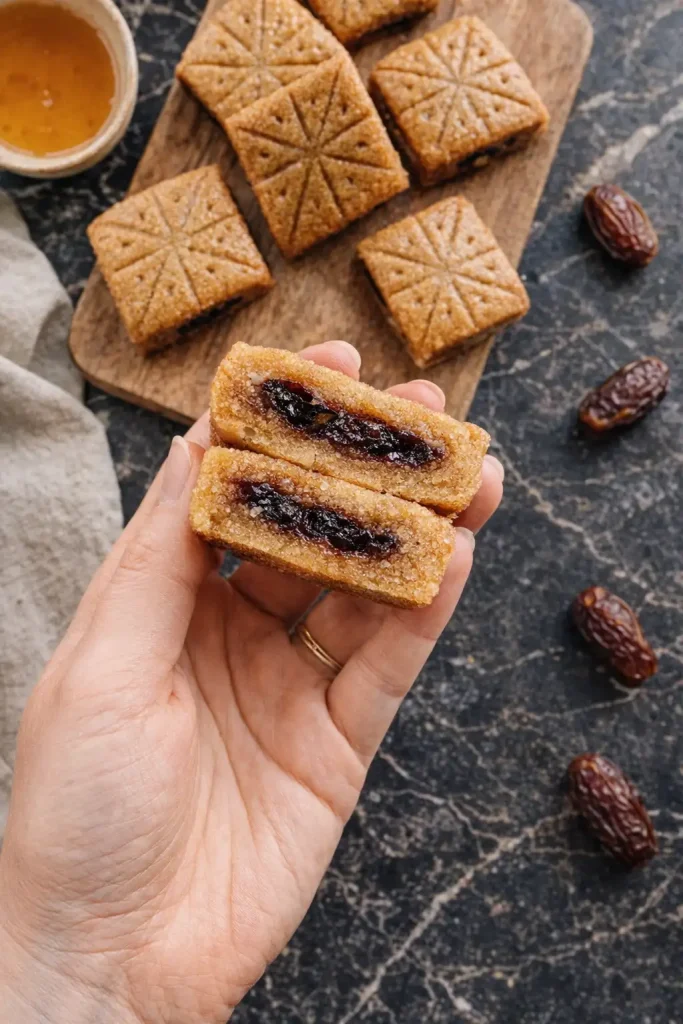
These cookies are tied to celebration. You’ll find them piled high on trays during Eid al-Fitr, at weddings, and at Ramadan gatherings. They’re also made in large batches because they keep well and taste even better after a day or two once the honey has had time to fully absorb into the semolina.
How to Get the Semolina Dough Right
The most common mistake people make with makrout dough is skipping the resting step or using the wrong type of semolina. Medium wheat semolina is the standard here, not fine semolina and not coarse. Fine semolina gives a softer, almost sandy result that doesn’t hold its shape well. Coarse semolina makes the dough rough and hard to work with.
The long resting period after combining the semolina with butter is what makes the dough manageable. The fat needs time to hydrate and coat each grain, which is what gives you that characteristic crumbly-but-cohesive texture. If you rush this step, the dough will crack when you try to shape it.
When adding the water and orange blossom water at the end, go slow. Add the liquids gradually and stop as soon as the dough comes together. Adding too much water makes the dough sticky and soft, and your cookies will puff and lose their edges during baking. Trust the feel of the dough.
Baked vs. Fried Makrout
Traditionally, makrout is fried in oil until deep golden, then immediately dipped in honey. The frying creates an extra layer of crunch on the outside while keeping the inside soft. It’s the version you’ll most often find in Tunisian and traditional Algerian recipes.
The baked version is lighter and easier for home cooks who don’t want to deal with a pot of hot oil. It takes a bit longer in the oven, but the result is still a golden, fragrant cookie with that same soft date center. I personally prefer baking because I find it easier to control the color and I can do a full tray at once without standing over the stove.
If you want to try the fried version, heat neutral oil to about 170-175°C and fry in small batches for 3-5 minutes, turning once. Remove when deep golden and immediately dip into the warm honey while still hot. The heat is what helps the honey absorb properly.
Storing and Making Makrout Ahead of Time
One of the best things about this recipe is how well these cookies keep. Once cooled and the honey has set, makrout can be stored in an airtight container at room temperature for up to two weeks. They actually improve after the first day because the honey slowly works its way into the semolina, making the texture softer and more cohesive.
For longer storage, freeze them in a single layer first, then transfer to a freezer bag or container. They keep up to three months in the freezer and thaw well at room temperature in about an hour. I sometimes make a double batch and freeze half specifically for holidays.
If you want to prep ahead, you can shape the raw cookies and refrigerate them on a tray overnight before baking. Just pull them out 20 minutes before you want to bake, let them come to room temperature, then proceed as usual.
Pro Tips for Perfect Makrout
- Use good quality date paste, or make your own by blending pitted Medjool or Deglet Noor dates with a teaspoon of butter until smooth.
- Don’t skip the orange blossom water in both the dough and the honey coating. It’s what gives makrout its signature floral fragrance.
- Let the semolina rest with the butter for at least an hour. Overnight gives the best dough.
- Dip the cookies in honey while they’re still hot from the oven. Hot cookies absorb the coating; cooled cookies will just be sticky on the outside without soaking through.
- A ruler or makrout mold makes it much easier to get uniform shapes and consistent sizing.
- If your dough cracks while shaping, it’s too dry. Add a tiny splash of water and knead gently.
- For cleaner cuts, wipe your knife blade between each slice.
- Scale up freely. This recipe doubles and triples well for Eid or large family gatherings.
Recipe FAQs
Can I make makrout without a mold?
A sharp knife and a ruler are all you need to cut clean diamond shapes. You can add the decorative lines on top using the back of a fork or a wooden skewer pressed lightly across each piece before baking. It won’t look identical to the molded version but it’s just as good.
Why did my makrout crack after baking?
Cracking usually means the dough was too dry when you shaped it. This can happen if the semolina absorbed all the liquid too fast, or if you worked the dough too much. Next time, add the water a little at a time and stop as soon as the dough holds together. A slightly sticky dough is better than a dry one for shaping.
Can I substitute the date paste with something else?
Date paste is really what makes this recipe. That said, some versions use fig paste or almond paste as an alternative. Almond makrout has a completely different flavor profile but follows the same technique. If you go the almond route, add a small pinch of cinnamon and a touch of orange blossom water to the filling for depth.
How long do homemade makrout keep?
Stored in an airtight container at room temperature, they keep well for 10-14 days. In the freezer, up to 3 months. The texture actually gets better after a couple of days as the honey settles in.
Print
Dates Cookies Makrout
- Total Time: 1 hour 15 minutes
- Yield: 20 cookies 1x
- Diet: Vegetarian
Ingredients
Semolina Dough
- 1 pinch salt
- 30 g orange blossom water
- 100 g water
- 160 g sweet butter, melted
- 500 g medium wheat semolina
Date Filling
- 1 tsp vanilla extract (liquid)
- 1 tbsp orange blossom water
- 10 g butter, melted
- 300 g date paste
Honey Coating
- 2 tbsp orange blossom water
- 250 ml honey
Instructions
- Rest the semolina. Place the medium wheat semolina in a large bowl, pour in the melted butter, and work it through with your hands using rubbing motions until every grain is coated. Cover with a clean cloth and let it rest for at least 1 hour (overnight is even better and gives a more cohesive dough).
- Finish the dough. Add the water, orange blossom water, and salt to the rested semolina. Mix with your hands just until a smooth dough forms. Don’t overwork it or you’ll lose that slightly grainy texture that makes makrout what it is. The dough should hold together without crumbling but still feel a little sandy.
- Make the date filling. In a bowl, combine the date paste with the melted butter, orange blossom water, and vanilla extract. Knead everything together until smooth and pliable. If the paste is too stiff, warm it for 20-30 seconds in the microwave to soften it slightly. Roll the filling into a long log about 1 cm thick and set aside.
- Shape the makrout. Divide the dough into portions and roll each into a rectangular log, roughly 4 cm wide and 2 cm thick. Press a channel down the center with your thumb. Lay the date filling log inside the channel, then fold the dough over and pinch the seam firmly to seal. Roll gently on the counter to smooth the shape back out.
- Cut into diamonds. Using a sharp knife, cut the logs diagonally at about 3-4 cm intervals to get the classic diamond shape. If you have a makrout mold or stamp, press it on top to add the decorative ridged pattern before cutting. Place the pieces on a parchment-lined baking tray.
- Bake. Preheat your oven to 180°C (350°F). Bake for 20-25 minutes until the bottoms are golden and the tops are just starting to color. Don’t overbake them, you want a pale golden cookie, not a brown one. They’ll look slightly underdone on top but will firm up as they cool.
- Prepare the honey coating. While the makrout are still hot from the oven, gently warm the honey and orange blossom water together in a saucepan over low heat until fluid and fragrant. Dip each hot makrout into the honey, let them soak for a minute, then lift them out and set on a wire rack to drain.
- Cool and serve. Let the honey-coated cookies drain and set for at least 30 minutes before serving. The coating will firm up slightly as it cools, leaving a beautiful glossy finish on each piece.
Notes
- Use good quality date paste, or make your own by blending pitted Medjool or Deglet Noor dates with a teaspoon of butter until smooth.
- Don’t skip the orange blossom water in both the dough and the honey coating. It’s what gives makrout its signature floral fragrance.
- Let the semolina rest with the butter for at least an hour. Overnight gives the best dough.
- Dip the cookies in honey while they’re still hot from the oven. Hot cookies absorb the coating; cooled cookies will just be sticky on the outside without soaking through.
- A ruler or makrout mold makes it much easier to get uniform shapes and consistent sizing.
- If your dough cracks while shaping, it’s too dry. Add a tiny splash of water and knead gently.
- For cleaner cuts, wipe your knife blade between each slice.
- Scale up freely. This recipe doubles and triples well for Eid or large family gatherings.
- Prep Time: 45 minutes
- Cook Time: 30 minutes
- Category: Cookies
- Method: Fried
- Cuisine: North African
Nutrition
- Serving Size: 1 piece
- Calories: 220 kcal
- Sugar: 14 g
- Sodium: 40 mg
- Fat: 10 g
- Saturated Fat: 2 g
- Unsaturated Fat: 7 g
- Trans Fat: 0 g
- Carbohydrates: 30 g
- Fiber: 3 g
- Protein: 3 g
- Cholesterol: 0 mg