
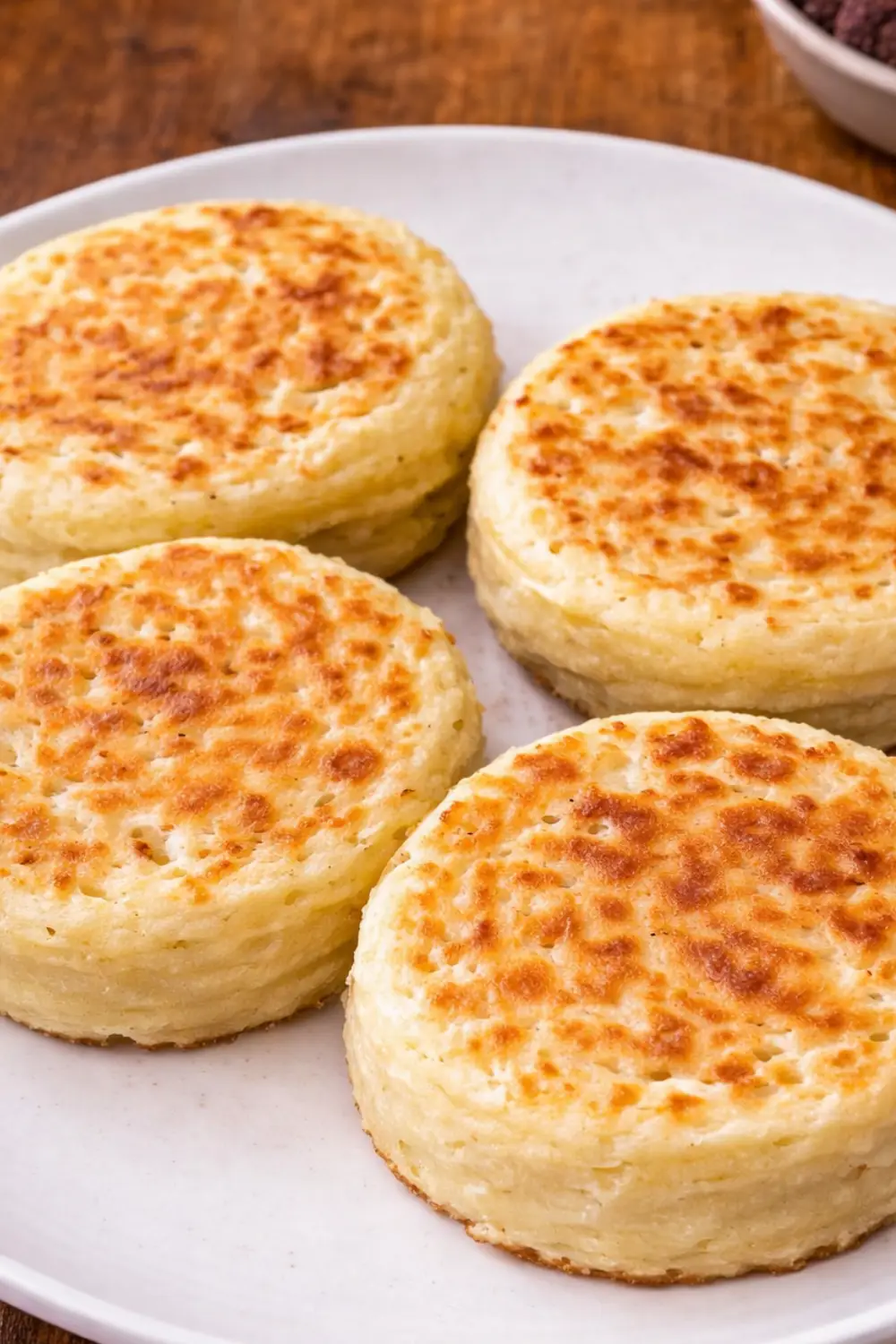
Traditional English crumpets are those delightfully holey griddle cakes that make breakfast feel special without much fuss. These soft, spongy treats have been a British teatime staple for generations, and making them at home is surprisingly straightforward once you understand the batter consistency. The key is getting that signature honeycomb texture on top, which comes from a looser batter than you might expect.
I started making these on rainy weekends, and now they’re my go-to when I want something warm and comforting. Serve them toasted with butter melting into all those little craters, and you’ll understand why the British have been obsessed with crumpets for centuries.
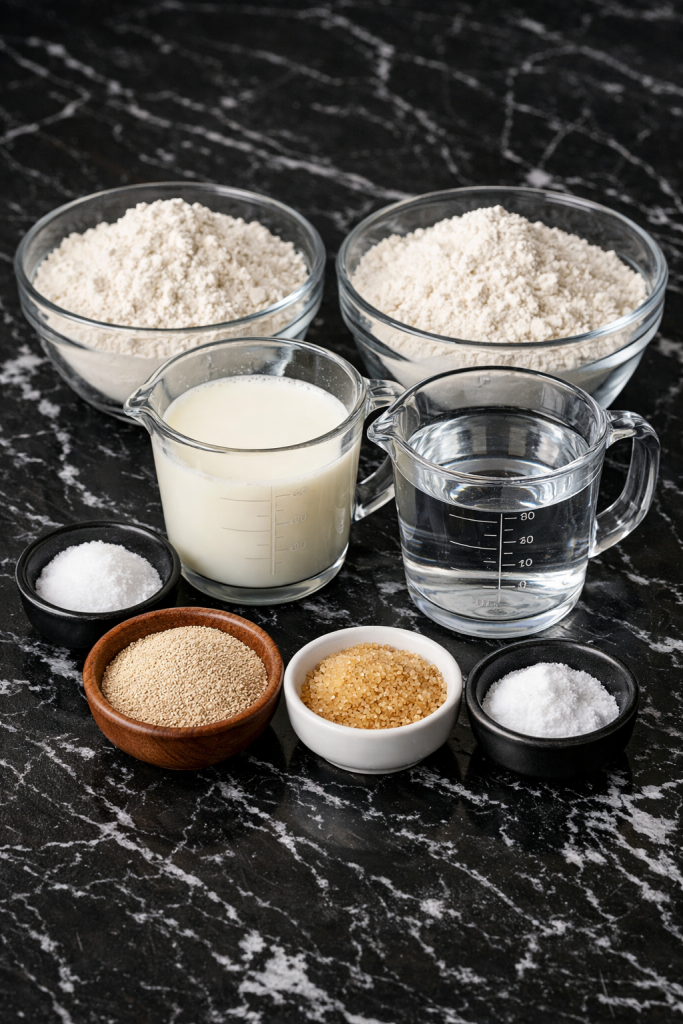
Ingredients For English Crumpets
- 2 cups all-purpose flour (can substitute half bread flour)
- 1 teaspoon salt
- 1 cup warm milk (about 110°F)
- 2 teaspoons active dry yeast
- 1 teaspoon cane sugar
- 1 cup warm water (about 110°F)
- 1/2 teaspoon baking soda
- Butter or oil for greasing rings and pan
How To Make Traditional English Crumpets
- Combine the warm milk, sugar, and yeast in a small bowl, then let it sit for 5-10 minutes until foamy and activated.
- Whisk together the flour and salt in a large mixing bowl, creating a well in the center.
- Pour the yeast mixture into the well and stir until you have a thick, smooth batter with no lumps.
- Cover the bowl with a damp towel and let it rise in a warm spot for about 60 minutes until doubled in size and bubbly.
- Mix the baking soda into the warm water until fully dissolved, then stir this into the risen batter until well combined and slightly thinner in consistency.
- Let the batter rest for an additional 10-15 minutes while you heat your griddle or heavy-bottomed pan over medium-low heat.
- Grease your crumpet rings (or cookie cutters) and the pan surface lightly with butter or oil.
- Place the rings on the heated pan and pour about 1/4 cup of batter into each ring, filling them halfway.
- Cook for 10-12 minutes without moving them until the tops are set, dry to the touch, and covered with holes.
- Remove the rings carefully (they’ll be hot), flip the crumpets, and cook for just 1-2 minutes on the other side to lightly brown.
Achieving the Perfect Crumpet Texture
The hallmark of authentic English crumpets is that spongy, hole-filled top surface that soaks up butter like magic. This texture comes entirely from the batter consistency and cooking method. Your batter should be thinner than pancake batter but thicker than crepe batter, it should pour easily but still hold some body.
Temperature control matters more than you’d think. If your pan is too hot, the bottom will burn before the top sets. If it’s too cool, you won’t get those distinctive holes forming. Medium-low heat gives the batter time to rise and create air pockets while cooking through evenly.
Don’t skip the second rise after adding the baking soda mixture. This step creates additional lift and contributes to that characteristic holey texture that separates crumpets from regular griddle cakes.
Serving Suggestions and Toppings
Fresh crumpets are good, but toasted crumpets are genuinely incredible. The toasting crisps up the edges while keeping the interior soft, and all those holes become perfect butter reservoirs. Just split them horizontally if they’re thick, or toast them whole.
The classic approach is simply salted butter, but you can branch out from there. Honey, jam, or marmalade work beautifully. Some people love them with cream cheese and smoked salmon for a savory breakfast. Marmite or Vegemite is traditional in the UK, though that’s admittedly an acquired taste.
For something different, try them as a base for eggs Benedict or topped with sautéed mushrooms and a poached egg. They’re sturdy enough to handle toppings without falling apart, which makes them surprisingly versatile beyond the breakfast table.
Storage and Reheating Tips
Crumpets keep well, which is why I usually make a full batch even for just myself. Once they’re completely cooled, store them in an airtight container or zip-top bag at room temperature for up to three days. They’ll stay soft and fresh without any special treatment.
For longer storage, freeze them in a single layer on a baking sheet first, then transfer to a freezer bag once solid. This prevents them from sticking together. They’ll keep frozen for up to three months without losing quality.
Reheating is simple, just pop them in the toaster straight from the freezer. No need to thaw first. They’ll toast up just like fresh ones, maybe taking an extra 30 seconds. The microwave works in a pinch, but you’ll miss out on that crispy exterior that makes toasted crumpets so satisfying.
Notes
- Crumpet rings are ideal, but 3-inch round cookie cutters work perfectly as substitutes, just make sure they’re at least 1.5 inches tall
- The batter should be pourable but thick enough to coat the back of a spoon; add a tablespoon of water if it seems too thick after rising
- Don’t flip them too early, the tops must be completely set and dry, or they’ll deflate and lose their texture
- A cast-iron skillet or griddle holds heat most evenly for consistent results across multiple batches
- If your crumpets aren’t developing holes, your batter might be too thick or your pan temperature too low, adjust accordingly for the next batch
- Leftover batter keeps in the fridge for up to 24 hours; just give it a good stir before using
English Crumpets FAQs
Can I make the batter the night before? Yes, you can mix the initial batter and let it rise in the refrigerator overnight. Just bring it back to room temperature before adding the baking soda mixture and cooking. The slower fermentation actually develops better flavor.
Why didn’t my crumpets get holes on top? This usually happens when the batter is too thick or the cooking temperature is too high. The holes form as steam escapes during slow, gentle cooking. Make sure your batter is quite loose and your heat is set to medium-low.
Can I make crumpets without special rings? Absolutely, use round cookie cutters, clean tuna cans with both ends removed, or even mason jar rings in a pinch. Just grease them well so the crumpets release easily after cooking.
How do I know when they’re done cooking? The top surface should be completely set, dry to the touch, and covered with holes. There shouldn’t be any wet batter visible, and the edges will start to pull away from the ring slightly when they’re ready to flip.
What’s the difference between crumpets and English muffins? Crumpets are cooked entirely on a griddle from batter and have one holey side, while English muffins are made from dough, shaped, and cooked on both sides more evenly. Crumpets are also spongier and not typically split before toasting.
Print
Traditional English Crumpets
- Total Time: 1 hour 15 minutes (includes 1 hour batter resting)
- Yield: 10 crumpets 1x
- Diet: Vegetarian
Ingredients
- 2 cups all-purpose flour (can substitute half bread flour)
- 1 teaspoon salt
- 1 cup warm milk (about 110°F)
- 2 teaspoons active dry yeast
- 1 teaspoon cane sugar
- 1 cup warm water (about 110°F)
- 1/2 teaspoon baking soda
- Butter or oil for greasing rings and pan
Instructions
- Combine the warm milk, sugar, and yeast in a small bowl, then let it sit for 5-10 minutes until foamy and activated.
- Whisk together the flour and salt in a large mixing bowl, creating a well in the center.
- Pour the yeast mixture into the well and stir until you have a thick, smooth batter with no lumps.
- Cover the bowl with a damp towel and let it rise in a warm spot for about 60 minutes until doubled in size and bubbly.
- Mix the baking soda into the warm water until fully dissolved, then stir this into the risen batter until well combined and slightly thinner in consistency.
- Let the batter rest for an additional 10-15 minutes while you heat your griddle or heavy-bottomed pan over medium-low heat.
- Grease your crumpet rings (or cookie cutters) and the pan surface lightly with butter or oil.
- Place the rings on the heated pan and pour about 1/4 cup of batter into each ring, filling them halfway.
- Cook for 10-12 minutes without moving them until the tops are set, dry to the touch, and covered with holes.
- Remove the rings carefully (they’ll be hot), flip the crumpets, and cook for just 1-2 minutes on the other side to lightly brown.
Notes
- Crumpet rings are ideal, but 3-inch round cookie cutters work perfectly as substitutes, just make sure they’re at least 1.5 inches tall
- The batter should be pourable but thick enough to coat the back of a spoon; add a tablespoon of water if it seems too thick after rising
- Don’t flip them too early, the tops must be completely set and dry, or they’ll deflate and lose their texture
- A cast-iron skillet or griddle holds heat most evenly for consistent results across multiple batches
- If your crumpets aren’t developing holes, your batter might be too thick or your pan temperature too low, adjust accordingly for the next batch
- Leftover batter keeps in the fridge for up to 24 hours; just give it a good stir before using
- Prep Time: 15 minutes
- Cook Time: 20 minutes
- Category: Breakfast
- Method: Stovetop
- Cuisine: British
Nutrition
- Serving Size: 1 crumpet (about 90 g)
- Calories: 130 kcal
- Sugar: 2 g
- Sodium: 230 mg
- Fat: 2 g
- Saturated Fat: 1 g
- Unsaturated Fat: 1 g
- Trans Fat: 0 g
- Carbohydrates: 25 g
- Fiber: 1 g
- Protein: 4 g
- Cholesterol: 5 mg