
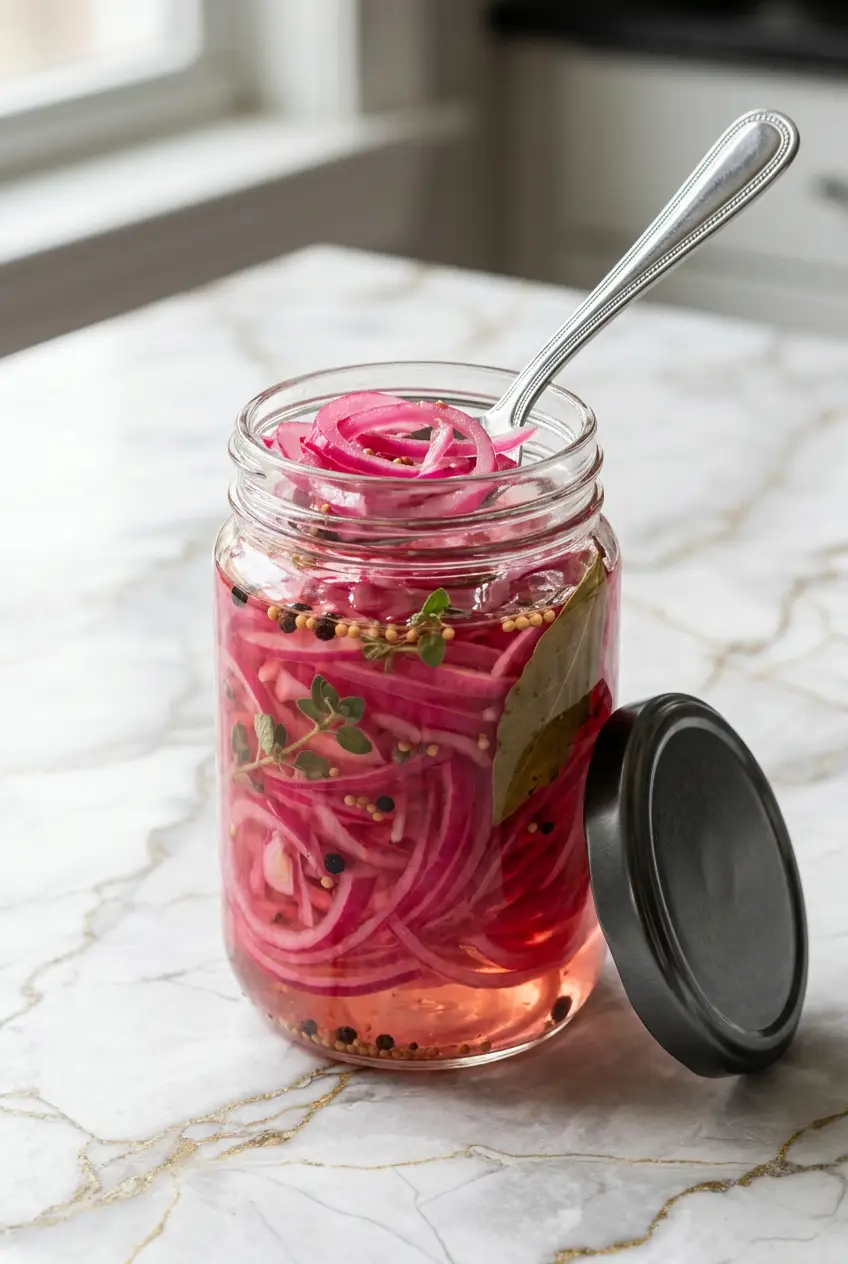
Quick pickled onions are the one condiment I genuinely keep stocked in my fridge year-round, and once you make your first jar, I think you’ll feel the same way. Just four ingredients, no stove required, and that beautiful rosy pink brine is ready to brighten up everything from tacos to scrambled eggs within the hour.
Ingredients
- 1 teaspoon sea salt
- 2 medium red onions
- 1 tablespoon maple syrup
- 2 cups warm water
- 1 cup white vinegar
How To Make Quick Pickled Onions
- Prep your jar. Wash a 16-ounce (pint-sized) mason jar with warm soapy water, rinse well, and set it aside to air dry completely before using.
- Slice the onions. Peel and halve both red onions lengthwise, then slice them into thin half-moons, about 1/8 inch thick. A sharp chef’s knife or a mandoline both work great here. Thinner slices absorb the brine faster.
- Pack the jar. Stuff the sliced onions firmly into your clean jar, leaving about an inch of space at the top. Don’t be shy about packing them in.
- Mix the brine. In a measuring cup or bowl, combine the 2 cups warm water, 1 cup white vinegar, 1 tablespoon maple syrup, and 1 teaspoon sea salt. Stir for 30 to 45 seconds until the salt fully dissolves into the liquid.
- Pour and submerge. Pour the brine over the onions, pressing them down gently with a fork or spoon to make sure every slice is fully submerged. If any onion rings are floating above the liquid, push them under.
- Seal and refrigerate. Screw the lid on tightly, give the jar a few gentle swirls to mix everything together, and place it in the refrigerator. Let them sit for at least 1 hour before eating, though 3 to 4 hours is better, and overnight is best.
What Do Quick Pickled Onions Taste Like?
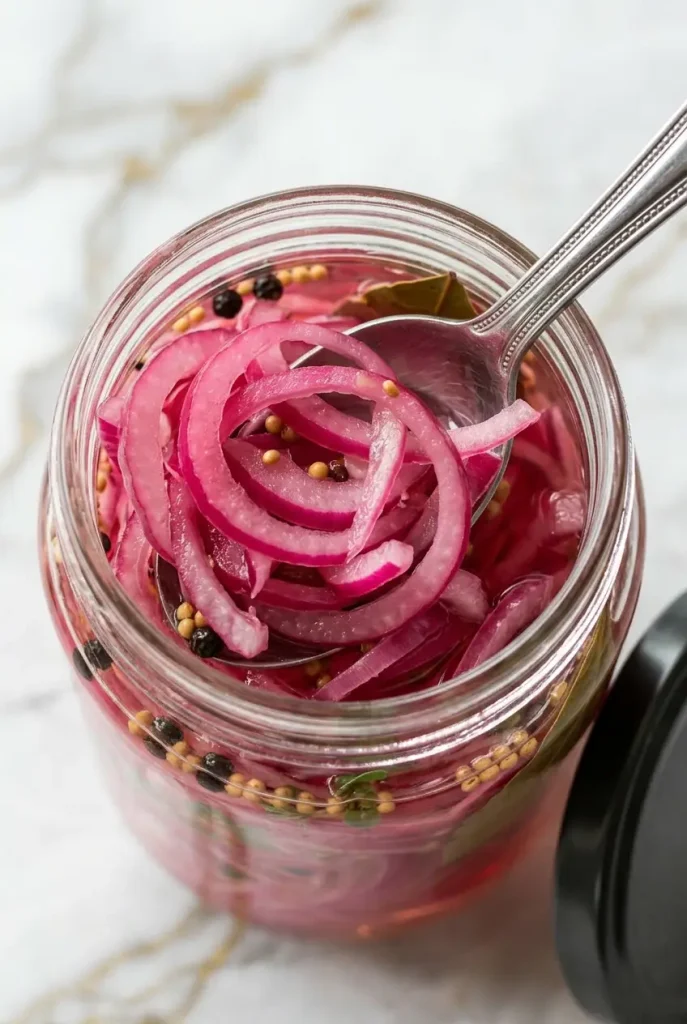
If you’ve only ever had raw red onions, the pickled version might surprise you. The sharp, almost nose-tickling bite of raw onion completely transforms in the brine. What you get instead is something tangy, lightly sweet from the maple syrup, and still firm enough to give you that satisfying crunch.
The color changes too, which is one of my favorite parts. Within an hour, the brine turns a vivid pink-magenta that looks almost too pretty to eat. It’s one of those things that makes any plate look more put-together without much effort at all.
What To Serve With Pickled Onions
The short answer is almost everything. I pile these on smash burgers, tuck them into crockpot shredded chicken tacos, and layer them onto avocado toast with everything bagel seasoning. They’re also incredible on a BLT chicken salad where that vinegary bite cuts right through the creamy dressing.
Beyond those obvious pairings, don’t overlook grilled fish, grain bowls, a good plate of fried eggs, or even just a cheese board. Anywhere you want a little zip and color, these onions show up and deliver.
Can You Customize the Brine?
Absolutely. The base recipe here is simple and clean, but there’s a lot of room to play around with it. A few peppercorns or a dried chili tossed into the jar before the brine goes in adds warmth without much extra work. A smashed garlic clove is another easy addition that deepens the overall flavor.
You can also swap the vinegar if needed. Apple cider vinegar gives a slightly mellower, fruitier result. Rice vinegar is lighter and a little sweeter. Red wine vinegar will deepen the color even more and bring a richer tangy note. Straight distilled white vinegar works fine, though it tends to be the sharpest of the bunch.
How Long Do Quick Pickled Onions Last?
Stored properly in a sealed jar in the fridge, these onions keep well for up to two weeks. The flavor actually gets better over the first few days as the brine works its way deeper into each slice.
The one thing to watch for is cloudiness in the brine or any off smell, both signs it’s time to start a fresh batch. Glass jars are the best container for this, since plastic absorbs the smell and metal reacts with the vinegar. A standard wide-mouth mason jar is all you need.
Quick Tips
- Slice onions as thin as possible for faster pickling and softer texture. A mandoline makes this much easier.
- Don’t skip the sweetener. Without it, the brine is noticeably sharp and one-dimensional.
- You can reuse the brine for a second batch if it’s still within the first week. Just top it up with a splash more vinegar and add fresh onions.
- For extra crunch, use slightly thicker slices (1/4 inch) and plan to wait overnight before eating.
- Scale the recipe up easily. Just keep the ratio of 1 cup vinegar to 2 cups water as your base and adjust salt and maple syrup accordingly.
- Store in glass, not plastic. The vinegar smell and color will leach into plastic containers.
Frequently Asked Questions
How long do quick pickled onions need before they’re ready to eat?
You can technically eat them after 30 to 60 minutes, but the flavor and texture are much better after 3 to 4 hours. For the best results, let them sit overnight in the fridge before using.
Can I use yellow or white onions instead of red?
Yes, any onion variety works with this brine. You won’t get that striking pink color, but the flavor profile will be similar. Red onions give the best visual result and tend to have a slightly milder, sweeter raw flavor than yellow.
Why are my pickled onions still too sharp or strong?
Two reasons this usually happens: the onions were sliced too thick, or they didn’t sit in the brine long enough. Thin slices and a longer resting time in the fridge both help the vinegar fully penetrate and mellow out the raw onion bite.
Can I freeze pickled onions?
Freezing isn’t recommended here. The texture becomes soft and mushy once thawed, losing most of that satisfying crunch. Since they keep well in the fridge for up to two weeks and take minutes to make, it’s much better just to batch them fresh as needed.
Print
Quick Pickled Onions
- Total Time: 15 minutes (plus at least 30 min resting time)
- Yield: 1 cups 1x
- Diet: Vegan
Ingredients
- 1 teaspoon sea salt
- 2 medium red onions
- 1 tablespoon maple syrup
- 2 cups warm water
- 1 cup white vinegar
Instructions
- Prep your jar. Wash a 16-ounce (pint-sized) mason jar with warm soapy water, rinse well, and set it aside to air dry completely before using.
- Slice the onions. Peel and halve both red onions lengthwise, then slice them into thin half-moons, about 1/8 inch thick. A sharp chef’s knife or a mandoline both work great here. Thinner slices absorb the brine faster.
- Pack the jar. Stuff the sliced onions firmly into your clean jar, leaving about an inch of space at the top. Don’t be shy about packing them in.
- Mix the brine. In a measuring cup or bowl, combine the 2 cups warm water, 1 cup white vinegar, 1 tablespoon maple syrup, and 1 teaspoon sea salt. Stir for 30 to 45 seconds until the salt fully dissolves into the liquid.
- Pour and submerge. Pour the brine over the onions, pressing them down gently with a fork or spoon to make sure every slice is fully submerged. If any onion rings are floating above the liquid, push them under.
- Seal and refrigerate. Screw the lid on tightly, give the jar a few gentle swirls to mix everything together, and place it in the refrigerator. Let them sit for at least 1 hour before eating, though 3 to 4 hours is better, and overnight is best.
Notes
- Slice onions as thin as possible for faster pickling and softer texture. A mandoline makes this much easier.
- Don’t skip the sweetener. Without it, the brine is noticeably sharp and one-dimensional.
- You can reuse the brine for a second batch if it’s still within the first week. Just top it up with a splash more vinegar and add fresh onions.
- For extra crunch, use slightly thicker slices (1/4 inch) and plan to wait overnight before eating.
- Scale the recipe up easily. Just keep the ratio of 1 cup vinegar to 2 cups water as your base and adjust salt and maple syrup accordingly.
- Store in glass, not plastic. The vinegar smell and color will leach into plastic containers.
- Prep Time: 10 minutes
- Cook Time: 5 minutes (only if heating brine)
- Category: Condiment
- Method: Pickling
- Cuisine: Universal
Nutrition
- Serving Size: 30 g
- Calories: 15 kcal
- Sugar: 2 g
- Sodium: 200 mg
- Fat: 0 g
- Saturated Fat: 0 g
- Unsaturated Fat: 0 g
- Trans Fat: 0 g
- Carbohydrates: 3 g
- Fiber: 0.5 g
- Protein: 0.3 g
- Cholesterol: 0 mg